Psychedelic-Assisted Psychotherapy
Informational only*
Psychedelic-assisted psychotherapy guides individuals into expanded states of consciousness to facilitate a deep healing process. In a controlled and safe environment, these therapies provide access to transformative experiences of introspection and self-awareness.
The substances used in this approach, which many of them originate from ancestral and shamanic traditions, have been misunderstood in the past. However, recent scientific studies have shown their low neurotoxicity and high effectiveness when used in a supervised therapeutic context. Approved in several regions worldwide, these substances have proven effective in treating conditions such as PTSD, treatment-resistant depression, anxiety, and addictions.
-
This process may support greater emotional clarity, deeper self-awareness, and a renewed sense of meaning and connection. Many individuals experience shifts in perspective that allow them to relate differently to past experiences, habitual patterns, and internal narratives. When approached with intention and proper integration, this work can facilitate emotional release, increased psychological flexibility, and a more embodied relationship with oneself and life.
Research and clinical practice have shown this approach to be particularly supportive for individuals navigating conditions such as anxiety, depression, trauma-related patterns, PTSD, grief, addiction, and challenges related to emotional regulation or life transitions.
-
In a therapeutic context, it is a structured and safe process designed for personal growth and healing. You are accompanied throughout the journey by a trained professional who provides a space of trust and security.
The experience allows you to access expanded states of consciousness, enabling a profound exploration of the Self, your inner world, and your essence. From a psychological perspective, this facilitates the release of emotions, the discovery of new perspectives, and greater clarity.
Each process and experience is entirely unique and special. Prior to the experience, proper preparation is conducted, followed by post-experience integration to ensure the insights gained are effectively incorporated into your life.
-
Psychedelics are substances that can temporarily alter perception, emotion, and patterns of thought, allowing access to inner experiences that are often less available in ordinary states of consciousness. Rather than numbing or suppressing experience, they tend to soften habitual mental defenses and open space for insight, emotional processing, and a broader sense of connection. Different substances interact with the nervous system in distinct ways, influencing areas related to emotion, memory, and self-referential thinking, which can support curiosity, meaning-making, and new perspectives on one’s inner life. When approached with intention, preparation, and integration, these states may facilitate psychological flexibility, spiritual reflection, and a deeper understanding of personal suffering and purpose.
-
Psychedelic-assisted therapies influence the brain by temporarily reshaping how neural networks communicate, supporting neuroplasticity and the formation of new connections. They also affect the default mode network, often quieting internal narratives and allowing for a greater sense of connection, perspective, and psychological flexibility. At the level of consciousness, these shifts may give rise to meaningful or visionary states that help individuals reframe personal suffering, access deeper understanding, and relate to their experiences with increased compassion and openness.
Many of these substances interact primarily with serotonin systems, particularly the 5-HT2A receptor, which plays a central role in perception, mood, and meaning-making. Different substances engage the brain in distinct yet complementary ways. Ketamine works through the NMDA receptor system, calming the nervous system while reducing activity in the amygdala and brainstem, which may ease fear-based responses and create access to introspection and expanded states of awareness. These neurochemical interactions can soften rigid patterns of thought and reduce habitual self-referential processing, allowing emotions, memories, and insights to surface with greater clarity.
When supported by a trained mental health professional and integrated within a therapeutic framework, these altered states can translate into lasting psychological relief and emotional integration, particularly in relation to trauma, anxiety, and depression.

From the Greek Psyche (soul) and Delos (to reveal), “Psychedelic” describes something that makes visible the parts of the soul and self that usually remain unseen.
The Process
A guided and intentional journey that unfolds through clearly defined stages, honoring both the therapeutic and the inner dimensions of the experience. The process begins with careful screening and preparation, creating a foundation of trust, emotional readiness, and clarity of intention. The therapeutic experience is then facilitated within a safe, contained, and distraction-free environment, where carefully held altered states of consciousness allow access to deeper layers of awareness, emotion, and insight. Rather than directing the experience, the facilitator provides presence and support, allowing the process to emerge organically. Integration completes the journey, helping translate what was revealed into embodied understanding and meaningful change in daily life, ensuring that the experience becomes a source of lasting healing, alignment, and personal transformation.
The Experience
The experience is a deeply personal and subjective process, unique to each individual. While no two journeys are the same, participants can expect a carefully held space where time slows and attention turns inward. Sessions typically unfold over several hours, allowing the experience to develop naturally without urgency or interruption. Music plays a central role, serving as a gentle guide that supports emotional flow, introspection, and inner navigation. The body remains at rest, often with eyes closed, as sensations, memories, images, and insights arise on their own rhythm. Rather than seeking a specific outcome, the experience invites openness, surrender, and trust in the process. What emerges is not forced or controlled, but revealed—often offering new perspectives, emotional release, and a renewed sense of connection with oneself and life.

The Outcome
How does this impact my daily life?
What remains beyond the experience is a deeper sense of clarity, emotional release, and reconnection with inner values and purpose. Through integration, insights are gradually woven into daily life, relationships, and patterns of behavior, allowing change to become grounded and sustainable. While many of these states and outcomes can be reached without the use of substances, this can be a valuable tool for many people.
What changes after the experience?
What often changes is not just how you feel, but how you perceive and process your inner world. Many people notice a shift in awareness, emotional clarity, and the way information, memories, and emotions are understood and integrated. These changes tend to unfold gradually, offering a new perspective rather than an immediate or forced outcome. The process is not linear, and the transformation often happens beyond what is immediately visible
Is this process worth it?
This work is not a quick or magical solution, nor is it the only path toward growth or healing. However, for many individuals who have navigated complex personal processes or feel a clear inner call, it can become a meaningful and supportive tool. It offers depth, perspective, and access to layers that may feel difficult to reach through conventional approaches alone.

No expectations. Simply be.

Brief History
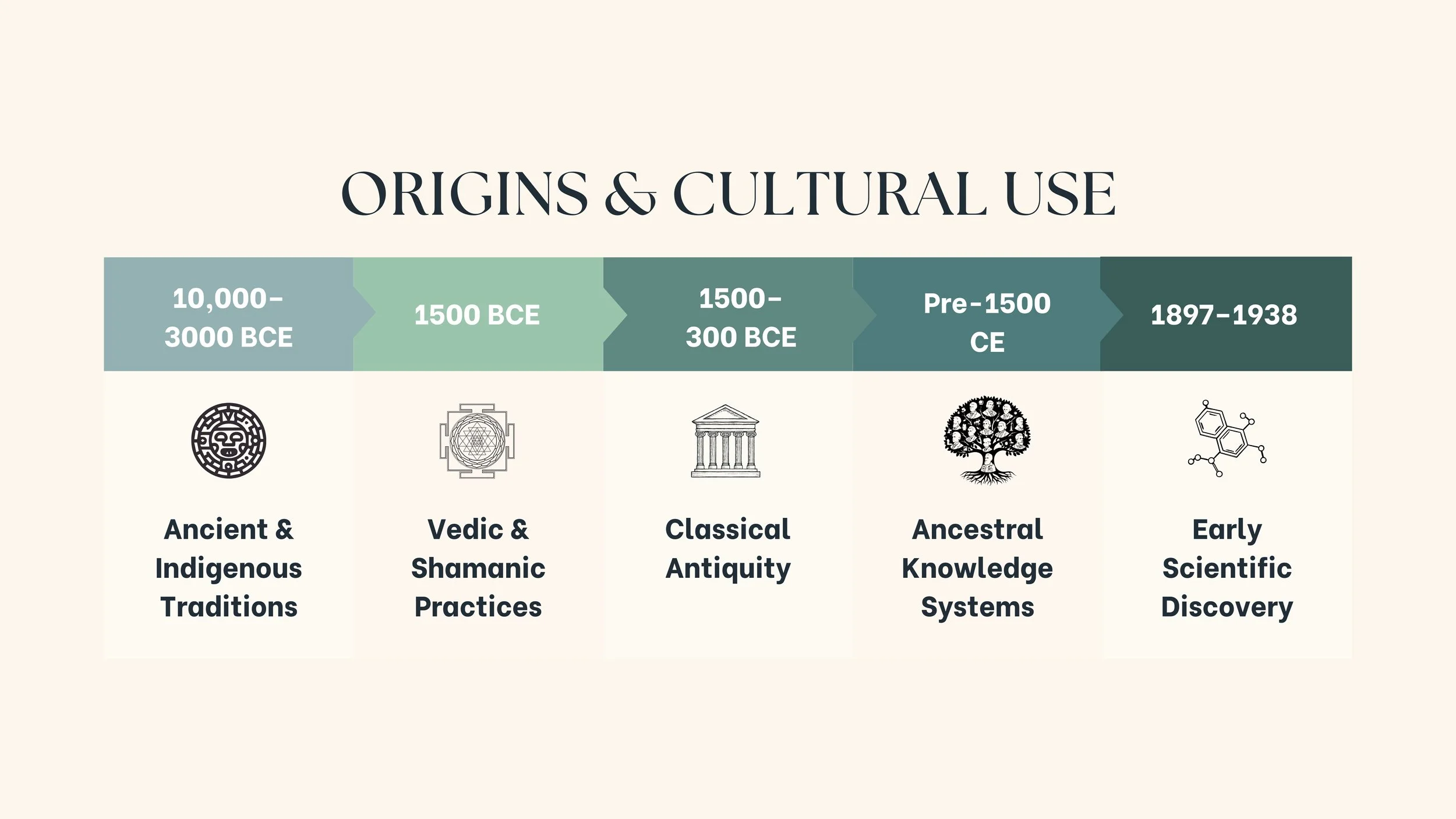
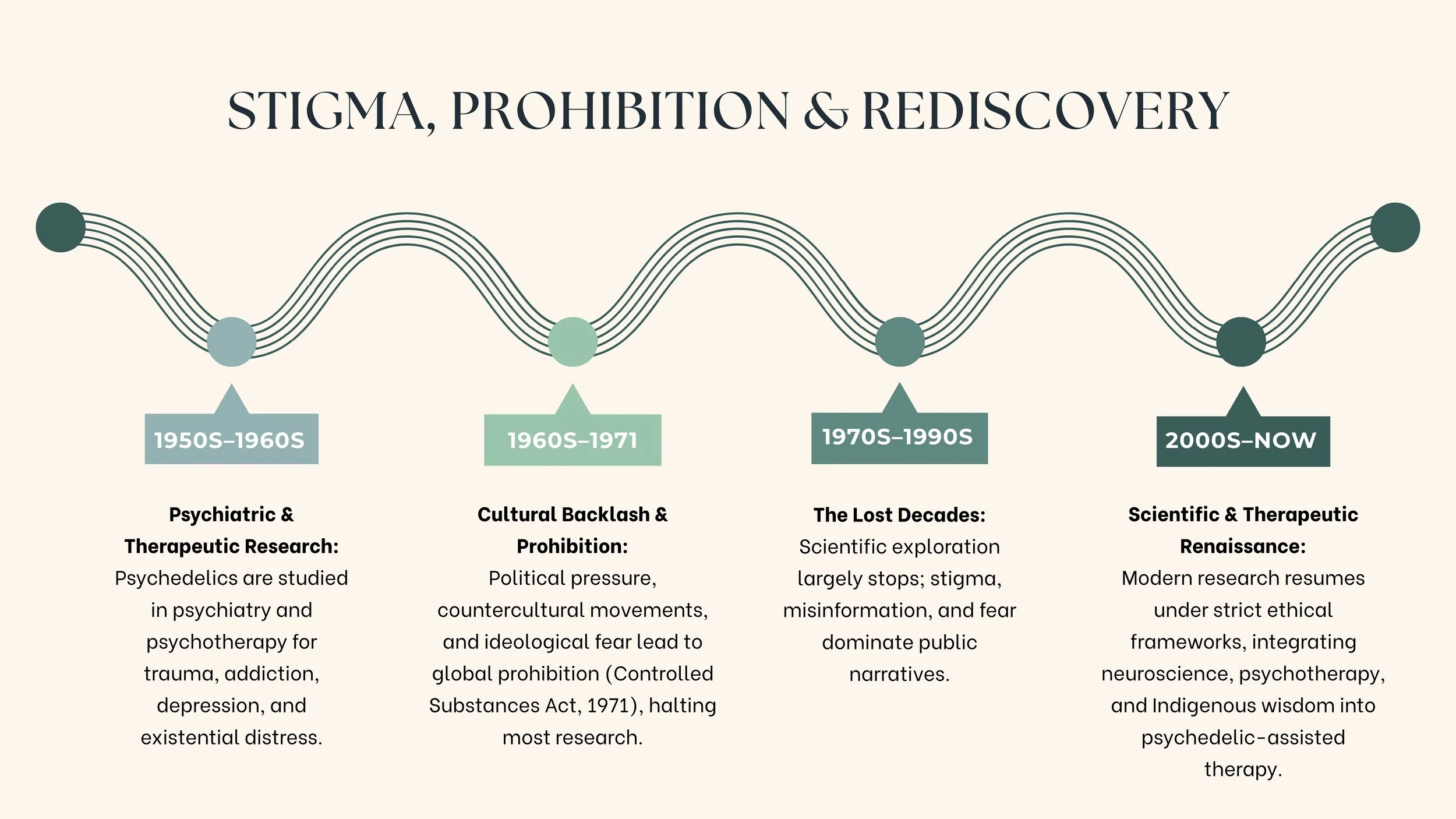
Psychedelics have a history that spans thousands of years, rooted in Indigenous and ancestral traditions where plant-based medicines were used for healing, ritual, and spiritual insight. These practices fostered connection, with the self, the community, and the natural world, and were considered sacred tools for understanding consciousness. In the 20th century, psychedelics entered Western scientific research, sparking early studies on the mind and mental health before decades of restriction followed. Today, a renewed wave of clinical and therapeutic exploration bridges ancient wisdom with modern science, offering a deeper understanding of their role in healing, self-discovery, and transformation.
Understanding the Taboo
Much of the stigma surrounding psychedelics stems not from their inherent nature, but from historical misuse, lack of education, and fear of altered states of consciousness. Detached from their original ceremonial and therapeutic contexts, these substances became associated with rebellion rather than healing, leading to misunderstanding and prohibition.
Reframing this narrative requires discernment: recognizing the difference between unstructured use and intentional, guided work grounded in safety, ethics, and respect.
A Conscious Perspective
From this perspective, psychedelic work is not approached as a trend, a shortcut, or an escape, but as a sacred encounter with consciousness itself. When held with intention, respect, and proper guidance, these experiences can support genuine awakening and inner transformation. Their true value lies not in the substance, but in the space that is created around it, the preparation, the presence, and the integration that allow insight to become embodied understanding. Treated with reverence and responsibility, this work becomes a pathway toward deeper awareness, healing, and a renewed relationship with the Self.

FAQs
-
It varies depending on the location and the substance. In countries such as the United States, Canada, Australia, and Switzerland, substances like psilocybin, MDMA, and ketamine have been approved for specific medical and therapeutic contexts, while in others they are still considered restricted. However, increasing scientific research has demonstrated their effectiveness in treating various conditions, highlighting their ability to promote neuroplasticity and facilitate profound transformations in controlled settings. An appropriate approach is based on providing a safe space, guided by trained professionals, and integrating best practices supported by science
-
This work is approached from a therapeutic, intentional, and integrative perspective. The focus is personal growth, healing, and self-understanding, not recreation or escapism. The type of substance used and its application depend on the therapeutic intention, individual needs, and professional assessment. Equally important is the context and environment in which the experience takes place, as a safe, structured, and supportive setting directly influences outcomes. When used responsibly within a guided therapeutic framework, these substances are not considered addictive, and the focus remains on the psychological process rather than repeated use.
-
Safety is a central priority and is supported through thorough screening, preparation, a supportive therapeutic setting, and post-session integration. Side effects vary depending on the individual and the substance and may include temporary changes in perception, emotions, or bodily sensations during the experience. These effects are generally mild and comparable to those of many other medications. Current scientific evidence indicates that, when used in controlled and supervised contexts, these substances do not show harmful neurotoxicity and are considered safe within therapeutic use.
-
While this varies by individual and context, most structured PAP protocols include several stages: preparatory sessions to build readiness and intention, one or more medicine-assisted sessions, and follow-up integration sessions to help incorporate insights into everyday life.
-
Ketamine-Assisted Psychotherapy (KAP) is a therapeutic approach that combines the administration of ketamine with psychotherapy. Ketamine is a widely recognized and safe anesthetic that has gained attention for its potential to treat mental health conditions such as depression, anxiety, and PTSD when used at sub-anesthetic doses. Within a controlled and supportive environment, ketamine can induce expanded states of consciousness, enabling individuals to access deeper emotional insights and perspectives that may not be easily reachable in standard therapeutic settings.
Public figures on psychedelics:
-
![]()
“Taking LSD was a profound experience, one of the most important things in my life.”
Steve Jobs
-
![]()
“The mind is not a producer of consciousness, but a reducer of it.”
Aldous Huxley
-
![]()
“Psychedelics are to the study of the mind what the microscope is to biology.”
Stanislav Grof
-
![]()
“People should be open to psychedelics… A lot of people making laws need to try them.”
Elon Musk
-
![]()
“LSD is a tool to turn us into what we are supposed to be.”
Albert Hofmann
-
![]()
“Psychedelics can dissolve the boundaries that keep us from seeing the world anew.”
Michael Pollan
-
![]()
"Psychedelics are really helpful for humans to process reality."
Bryan Johnson
-
![]()
"Heal yourself, with beautiful love, and always remember: you are the medicine."
María Sabina









Resources Library
Where science meets consciousness. Evidence-based knowledge to guide inner healing and transformation.
Scientific
Articles & Papers
Books &
Recommended Reading
Documentaries
/ Talks /Podcasts
The Science of Psychedelics for Mental Health | Dr. Robin Carhart-Harris
Joe's Epic Rant About Psychedelics - Animated by After Skool
Professional
Organizations
Safety & Ethics -
Preparation & Integration
The information provided in this section is strictly for educational purposes and does not constitute encouragement or recommendation for recreational use of psychedelics. All content focuses on clinical, scientific and therapeutic contexts within legal and ethical frameworks.*